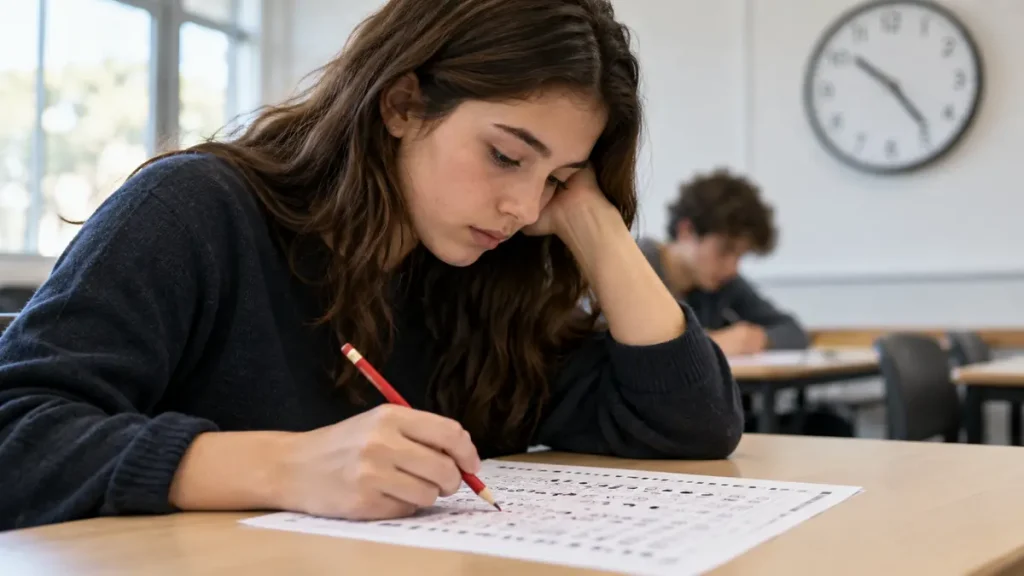
A practice exam is most valuable after you finish it. The score tells you where you are today; the review tells you what to do next. Treating every wrong answer as the same kind of mistake leads to vague revision. A better review separates knowledge gaps, method errors, question-reading problems, and timing issues so that each one gets a different response.
Protect the first attempt
When possible, complete the practice under conditions that resemble the assessment: use the allowed resources, set a time limit, and avoid checking answers during the attempt. This gives you honest evidence about recall, pacing, and decision making. A perfect open-note practice session may feel reassuring but cannot reveal what you can do independently.
You do not need to simulate every condition every time. Early practice can be open-book while you learn a method. As the exam approaches, add more realistic attempts. A calm exam plan can help you place these attempts before the final days rather than saving them for a panic test.
Classify each mistake before revising
Use a simple label: knowledge, interpretation, method, execution, or time. A knowledge error means you did not know or could not retrieve something. An interpretation error means you misread what was asked. A method error means you knew the material but chose an unsuitable approach. Execution includes arithmetic, units, grammar, or missing steps.
The labels prevent a common mistake: responding to every wrong answer by rereading a chapter. If the issue was timing, you need shorter timed sets. If the issue was a misread command word, you need to slow down at the question. If the issue was a concept, you need targeted retrieval and explanation.
Write a correction that teaches you something
For each important error, write the correct answer, the reason it is correct, and the clue you missed. The clue might be a word in the question, a condition in a formula, or an assumption in the topic. Make the correction short enough to review later.
Avoid copying a model answer without thinking. Cover it and reproduce the explanation or calculation yourself. This converts feedback into another retrieval opportunity. If you cannot do it a second time, the correction is not yet a learned lesson.
Build a small error bank
Keep errors from several practice sessions in one place. Group similar ones: definitions you confuse, question types that slow you down, steps you omit, or topics that are not yet secure. Patterns matter more than a single awkward question.
Turn the repeated patterns into targeted drills. For instance, if you lose marks by not explaining evidence, practise five short “claim plus evidence” responses. If you mix two formulas, make a decision table or teach the difference aloud. Self-testing in more than one format makes these drills less repetitive and more revealing.
Retest after the correction
A correction only becomes useful when you meet the idea again later. Retest the same skill after a day or two with a slightly changed question. Then include it in a mixed set so you must decide when it applies. This step is what stops a review from becoming a one-time apology to the answer key.
After each retest, update the label. Some errors will disappear quickly; others will show that you need a different explanation, more foundational practice, or a question for the instructor. The aim is steady diagnosis, not a spotless record.
Practical checklist
- Complete some practice under realistic conditions.
- Label each error by type before revising.
- Write the correct answer and the missed clue.
- Group repeated errors in one bank.
- Create a focused drill for each common pattern.
- Retest after a delay and in a mixed set.
Frequently Asked Questions
Should I redo the same practice paper?
Yes, after enough delay to make retrieval meaningful. Also use changed questions so you practise the skill, not only the answer order.
What if I score badly on a practice exam?
Use the result as a map. Start with the highest-value pattern rather than trying to relearn everything at once.
A useful next step
Review one recent wrong answer today. Give it a label, write the missed clue, and schedule one retest instead of simply reading the solution again.
For further evidence-based learning guidance, see The Learning Scientists: practice testing.